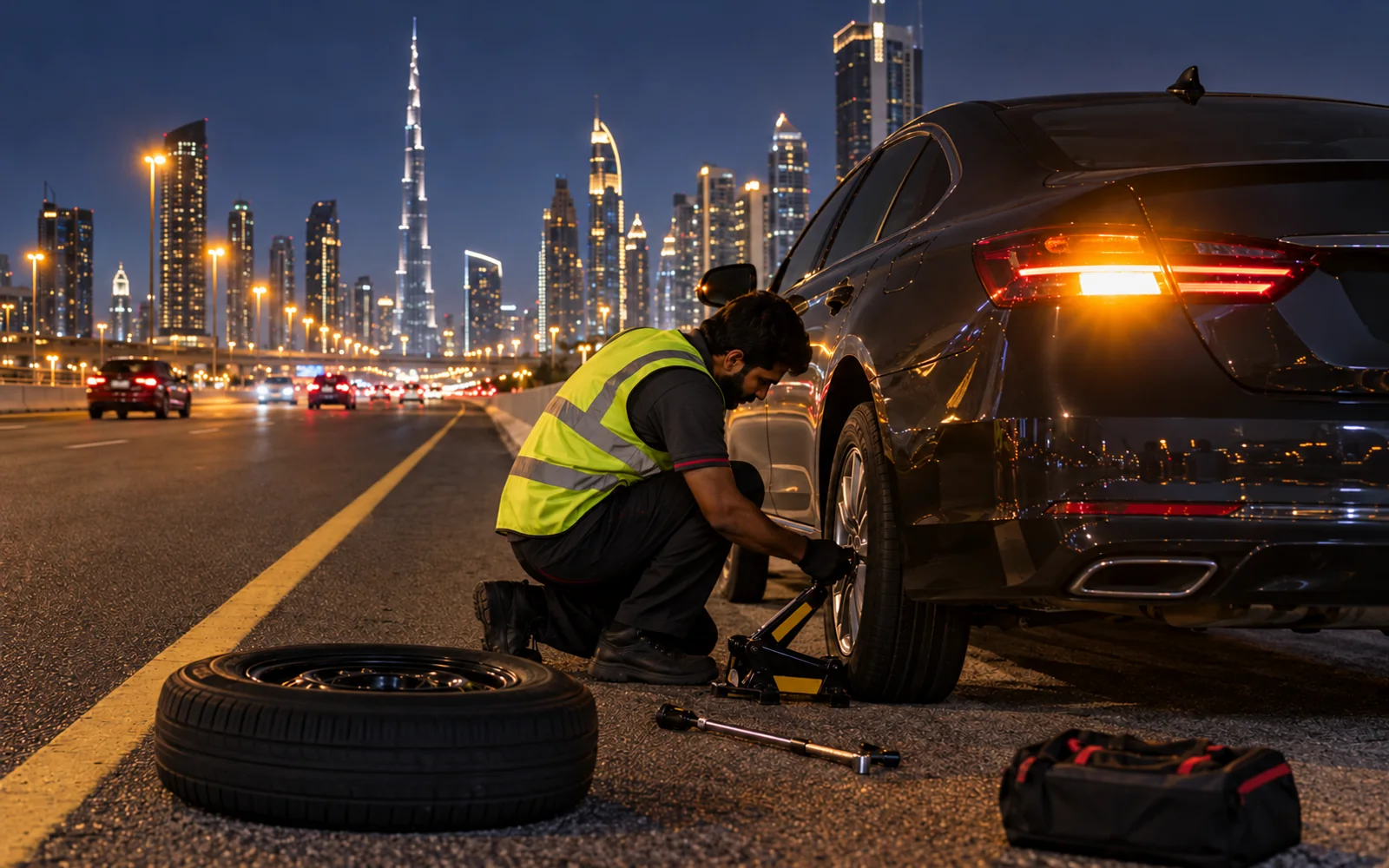






A tyre puncture is repairable when the hole is in the central tread, no wider than about 6 mm, and the tyre has not been driven flat. Our tyre puncture repair near me service sends a technician to your car anywhere in Dubai, Abu Dhabi, Sharjah or Ajman, 24 hours a day. The tyre comes off the rim, the inside is checked for hidden damage, and the hole is sealed with a plug-patch from the inside, the same method a good workshop uses. If the damage is outside the repairable zone, we tell you straight away and quote a replacement on WhatsApp before any work starts.
Which punctures can be repaired
Only punctures in the central tread area, up to about 6 mm across, qualify for a safe repair. The sidewall flexes thousands of times per kilometre and the shoulder carries heavy cornering loads, so a repair in either place cannot hold and the tyre must be replaced.
The second test happens inside the tyre. If the car was driven even a short distance with low pressure, the sidewall gets pinched between rim and road and the inner liner shows a grey, dusty ring or creases. That tyre is finished, even if the nail hole itself looks small.
- Repairable: nail, screw or small stone hole in the tread, up to about 6 mm
- Not repairable: anything in the sidewall or shoulder
- Not repairable: cuts or tears longer than a round puncture
- Not repairable: tyres driven flat, with liner damage or a heat-darkened inner surface
- Not repairable: a new hole overlapping an old repair
Plug, patch or plug-patch: the right tyre puncture repair near me
The plug-patch, often called a mushroom repair, is the only method that both fills the hole and seals the inner liner. Its stem fills the channel the nail made through the steel belts, and its patch head bonds to the liner from the inside.
A string plug pushed in from outside is a roadside get-you-home fix. It can hold air for weeks, but moisture and sand still reach the steel belts and nobody has looked inside the tyre. A patch on its own seals the liner but leaves the channel open, so water creeps along the belts and rust can start a separation later.
For a plug-patch, our technician demounts the tyre, marks the hole, drills the channel clean, buffs the liner, applies vulcanising cement, pulls the stem through from inside and rolls the head flat. The tyre is then remounted, balanced and inflated to the pressure on your door placard.
How many repairs one tyre can take
Common industry practice allows two repairs per tyre, and the repairs should not overlap or sit close together, ideally at least 40 cm apart around the tread. Beyond that, the belt package has been drilled too often and the tyre is better replaced.
Speed rating matters too. Some makers downgrade the speed rating of a repaired high-performance tyre, and many run-flat manufacturers advise against repairing at all. On a BMW or Mercedes with run-flats we check the tyre maker's policy before quoting a repair.
Screws and nails from construction-zone roads
Most punctures we repair are drywall screws, roofing screws and bent nails picked up near active building sites. Roads around new communities such as Dubai South, Al Furjan, JVC and Arjan carry a steady flow of trucks shedding fixings, and the debris collects at roundabout exits and site gates.
A screw usually stays lodged in the tread and seals itself partly, so the tyre loses air slowly rather than going flat at once. Leave it in place until the repair. Pulling it out in the car park turns a slow leak into a flat tyre and makes it harder to find the exact angle of the hole.
If you live or work near a construction zone, glance at the tread every couple of weeks. A shiny metal head in the centre grooves is easy to spot and cheap to fix while the tyre still holds pressure.
The morning soft tyre: how slow punctures show up
A tyre that looks soft every morning but fine by afternoon usually has a slow puncture. Hot tyres from the evening drive hold more pressure, and as the car cools overnight the pressure drops by roughly 1 psi for every 5 to 6 degrees, which hides a small leak during the day.
The test is simple: set all four tyres to the placard pressure in the morning, then check again the next morning before driving. A healthy tyre will be within 1 psi. A tyre that has lost 3 psi or more has a leak, and in the tread that is most often a screw or nail that is easy to repair.
Repair visit or new tyre: what it costs
A repair is a fraction of the cost of a new tyre. The mobile visit starts from AED 100 and the repair itself is quoted on WhatsApp before dispatch, while a mid-range 205/55 R16 for a Corolla or Elantra costs about AED 300 to 420 and a mid-range 265/65 R17 for a Prado or Hilux about AED 480 to 650.
Repair makes sense when the tyre is under about 5 years old by its DOT code and has good tread left. If the tyre is already near 5 years, low on tread, or the hole is outside the repairable zone, we quote a replacement from van stock and you can pay by card, cash, Tabby or Tamara.