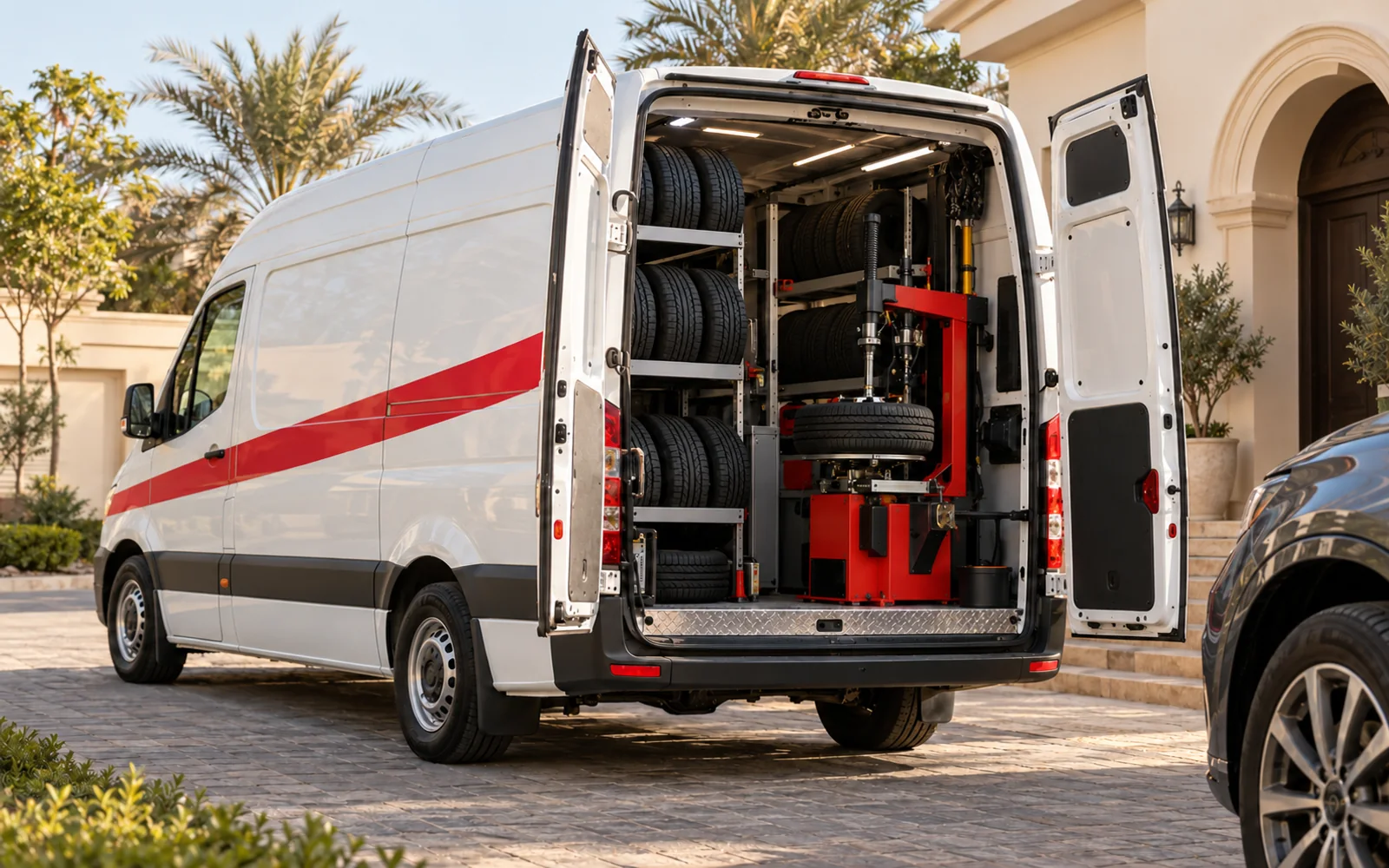






Wheel balancing with 800 UAE Tyres costs from AED 100 for all four wheels and is done at your home or office on a computerised balancer carried in our vans. Balancing removes the vibration you feel through the steering wheel or seat, usually between 90 and 130 km/h. It takes about 30–50 minutes and is the most common fix for a car that shakes on Sheikh Zayed Road but feels fine in town.
What's included
- Removal and balancing of all four wheels on a computerised dynamic balancer
- Removal of old weights and cleaning of the rim surface
- Stick-on weights on alloys, positioned behind the spokes where possible
- Check for stones in the tread, bent rims and tyre bulges that cause vibration
- Wheel nuts torqued to specification on refit
- Pressure check and adjustment on all tyres
Signs you need it
- The steering wheel shakes at a particular speed, often 100–120 km/h
- You feel vibration through the seat or floor on the highway
- A balance weight has fallen off, leaving a clean mark on the rim
- You have had a tyre repaired, refitted or rotated
- Tyres show patchy, scalloped wear
How the job runs
- Describe the vibration. Tell us when it happens: the speed range, and whether you feel it in the steering wheel (usually front wheels) or the seat and floor (usually rear wheels).
- Wheels on the balancer. Each wheel is spun on the balancer, which measures heavy spots on both the inner and outer plane of the rim and shows the weight and position needed.
- Weights fitted and rechecked. Weights are applied and the wheel is spun again to confirm it reads zero, or within a gram or two. Any rim run-out or tyre defect found is shown to you.
- Refit and test. Wheels go back on and are torqued in the correct sequence. A short drive confirms the vibration has gone.
What wheel balancing fixes
Wheel balancing fixes vibration caused by uneven weight around a wheel and tyre. A difference of as little as 15–20 grams on one side of a 17 inch wheel is enough to produce a noticeable shake at highway speed, because the heavy spot is pulling outward hundreds of times a minute.
The vibration usually appears in a band, for example from 95 to 125 km/h, and fades above or below it. Front-wheel imbalance comes through the steering wheel; rear-wheel imbalance comes through the seat and floor and is easy to mistake for a driveline problem.
Balancing does not cure a car that pulls to one side; that is alignment. It also cannot cure a bent rim or a tyre with an internal belt fault, but a good technician will spot both on the balancer.
Why wheels lose balance
Wheels go out of balance as tyres wear unevenly, when a stick-on weight falls off, or after a repair or refit. Stick-on weights are a particular issue in the UAE: adhesive softens in summer heat and weights placed on dusty rims can slide or drop off within months.
Other causes are easier to miss. Sand and mud packed inside the rim after a desert trip can throw a wheel out of balance until it is cleaned. A flat spot from a hard brake, or a tyre left standing on a hot surface for weeks, can also cause a vibration that balancing partly hides.
- Weights detached by heat, car washes or kerb contact
- Uneven tread wear changing the weight distribution
- Sand or mud packed inside the rim after off-roading
- Tyre repaired or remounted without rebalancing
- Bent rim from a pothole or speed bump
Balancing at your location with the same equipment as a workshop
Our vans carry a full-size computerised wheel balancer, the same type used in fixed tyre shops, powered from the van. That means wheel balancing can be done properly in a villa driveway or a car park rather than by guesswork.
For alloy wheels we use stick-on weights placed on the inside of the rim, hidden behind the spokes, so they are not visible and do not scratch the face. Steel wheels on pickups and older 4x4s use clip-on weights on the rim edge.
When to balance and what it costs to skip it
Balance the wheels whenever a tyre is fitted, repaired from inside or remounted, and check balance every 10,000 km or at each rotation. If a vibration appears suddenly, have it checked within a week or two.
Driving with an unbalanced wheel is not immediately dangerous, but the constant vibration wears tyres in patches and accelerates wear on wheel bearings, ball joints and steering rack ends. On a car doing 2,000 km a month on UAE highways, that damage adds up quickly.
Pricing
Wheel balancing starts at AED 100 for all four wheels at your location, including weights and a pressure check. Large 4x4 wheels over 20 inches or heavily soiled off-road wheels may cost a little more, confirmed before booking. Balancing is included free whenever we fit new tyres.