





The short answer
- Legal minimum tread
- 1.6 mm, but replace at 3 mm for safe wet braking
- Pressure check
- Monthly with tyres cold, and before every long trip
- Rotation interval
- Every 8,000–10,000 km, or at every oil service
- Wheel alignment
- Once a year, after a hard kerb or speed-bump hit, and with new tyres
- Maximum tyre age in the UAE
- About 5 years from the DOT date, regardless of tread
- Bulge on the sidewall
- Replace immediately; it cannot be repaired
Tread depth: 1.6 mm is legal, 3 mm is sensible
The UAE legal minimum tread depth is 1.6 mm, and an RTA vehicle test will fail a tyre below it, but most technicians advise replacing at 3 mm. Between 3 mm and 1.6 mm a tyre still grips well on dry asphalt, yet its grooves can no longer clear water fast enough, so braking distances on a wet road grow sharply and the car starts to aquaplane at lower speeds.
Rain is rare here, which is exactly why it catches drivers out. The first heavy shower of winter lifts months of oil and dust off the road surface, and a car on worn tyres doing 100 km/h on Emirates Road can lose steering in standing water within seconds. New tyres start at roughly 7–8 mm for passenger cars and 10–12 mm for SUV all-terrain patterns, so 3 mm means most of the useful life is already gone.
Every tyre has tread wear indicator bars: small raised blocks across the bottom of the main grooves, marked by a triangle or the letters TWI on the shoulder. When the tread surface is level with those bars, the tyre is at 1.6 mm and must be replaced. Check the inner, centre and outer grooves, because a tyre that looks fine on the outside can be bald on the inside edge.
- Gauge check: a tread depth gauge costs a few dirhams at any accessories shop and gives an exact reading in seconds.
- Coin check: push a 1 dirham coin into the main groove; if the groove does not reach the inner ring of the coin, the tyre is getting close to 3 mm and needs a proper measurement.
Pressure, valves and TPMS
Check tyre pressure once a month and before any long drive, with the tyres cold, using the figure on the driver's door pillar rather than the maximum printed on the sidewall. A tyre can lose 1–2 psi a month through normal permeation, and every 10°C change in air temperature shifts pressure by about 1 psi, so a car set correctly in a January morning will read differently in an August afternoon.
Under-inflation is the most common cause of the sudden blowouts seen on UAE highways in summer. A soft tyre flexes more, the sidewall heats up, and at 120 km/h on hot asphalt that heat builds faster than it can escape. Nitrogen, which many UAE shops offer, leaks a little more slowly than air, but it does not replace the monthly check.
Valve caps keep sand and moisture out of the valve core, so replace any that are missing. Rubber valve stems harden and crack in the heat and should be renewed whenever a tyre is replaced. Cars with TPMS sensors use metal valve stems with seals that also need replacing, and the TPMS warning light should never be ignored: it usually means at least one tyre is 20–25% below its set pressure. A mobile pressure check from 800 UAE Tyres starts from AED 100 and covers all four tyres plus the spare.
Rotation every 8,000–10,000 km
Rotating tyres every 8,000–10,000 km evens out wear and can add several thousand kilometres to a set. Front tyres on a front-wheel-drive Corolla, Sunny or Altima carry the engine weight, the steering and the drive force, so they wear noticeably faster than the rears. Rotation spreads that work across all four tyres.
The pattern depends on the tyre and the car. Directional tyres, marked with an arrow on the sidewall, must keep rolling the same way, so they move straight front-to-back on the same side. Non-directional tyres use a cross pattern: on front-wheel drive the fronts go straight back and the rears cross to the front, and on rear-wheel or four-wheel drive the opposite applies.
Staggered setups, where the rear tyres are wider than the fronts as on many BMW, Mercedes and Mustang models, cannot be rotated front to rear at all. On those cars you watch the rears closely and expect to replace them more often.
Alignment and balancing
Wheel alignment should be checked once a year and after any hard hit, because a car that is even slightly out of alignment scrubs rubber off the tyre with every kilometre. The usual signs are a car that drifts to one side on a straight road, a steering wheel that sits off-centre when driving straight, and wear that is feathered across the tread or concentrated on the inner edge.
Residential areas across Dubai, Sharjah and Abu Dhabi have tall speed bumps and high kerbs, and one fast hit can knock the toe setting out. Have alignment checked after any such impact, after fitting new tyres, and after suspension work such as new shocks, bushes or tie-rod ends.
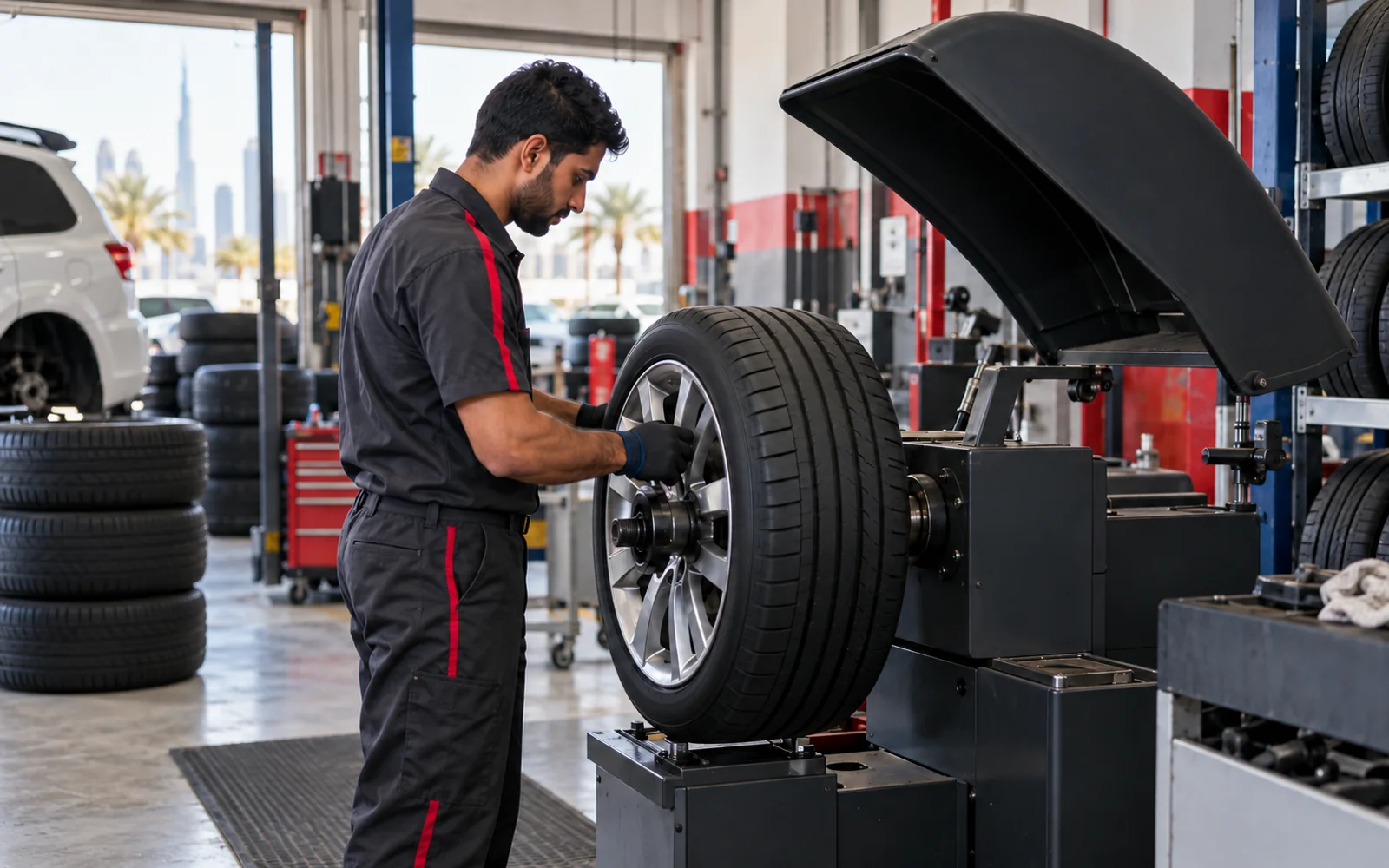
Balancing is a separate job: small weights are fixed to the rim so the wheel spins without wobble. An unbalanced wheel usually shows up as a vibration through the steering wheel or seat at around 100–120 km/h, which is why many drivers first notice it on Sheikh Zayed Road or Mohammed bin Zayed Road. Every new tyre must be balanced when fitted, and a wheel should be rebalanced if a weight falls off, after a puncture repair, or whenever that vibration appears.
Heat ageing, DOT dates and sidewall damage
In the UAE a tyre should be replaced at about 5 years old regardless of how much tread is left, because rubber oxidises and hardens much faster when it sits on 60–70°C asphalt every summer. An old tyre can look fine, yet it grips less, cracks more easily and is more likely to separate at speed.
The age is in the DOT code on the sidewall: the last four digits give the week and year of manufacture, so 1824 means week 18 of 2024. When buying new tyres, check this code before fitting and refuse anything more than about 2 years old, since part of its life has already been used in a warehouse.
Inspect the sidewalls every few weeks. Fine surface cracking, often called crazing, is an early sign of heat ageing; deeper cracks that open when you press the rubber mean the tyre is due for replacement. A bulge or bubble means the internal cords are broken, usually after a pothole or kerb hit, and that tyre must be replaced immediately because it can burst without warning. Cuts that expose cords, and any damage on the sidewall or shoulder, cannot be repaired.
Parking, storage and the spare tyre
Where you park matters almost as much as how you drive, because direct sun and UV light age rubber even when the car is not moving. Park in shade or a covered or basement bay where possible, and if a car will sit for weeks while you travel over summer, use tyre covers or a full car cover, set pressure to the door-pillar figure plus 3–4 psi, and move the car a short distance every week or two to avoid flat spots.
Spare or seasonal tyres, such as a set of all-terrains kept for desert season, should be stored somewhere cool, dark and dry, away from ozone sources like electric motors, generators and water pumps. Store mounted wheels stacked flat, and unmounted tyres standing upright, turning them every month. Never leave a spare set loose in the boot all summer, where temperatures can pass 70°C.
Check the spare's pressure every month along with the others; a space-saver usually needs about 60 psi. Look at its DOT date too, since many spares in UAE cars are as old as the car itself. A space-saver is typically limited to 80 km/h and short distances, so it is a way to reach a safe place, not a replacement.
After-care for sand and desert driving
After a desert trip the most important job is to re-inflate from dune pressure, usually 15–18 psi, back to road pressure before driving on tarmac at speed. Running a soft tyre at 100 km/h on the E11 or the Al Ain road overheats the sidewall within minutes, and that damage may not show until the tyre fails weeks later.
Once home, rinse sand out of the tread, wheel barrels and valve caps, and look closely at the sidewalls for cuts from rocks, shrub roots or buried debris. Low pressure in sand also pushes the bead against the rim edge, so check for slow leaks over the next few days. If the steering feels different after a day in the dunes, have the wheels balanced, because packed sand inside the rim can throw the balance off.
| Task | How often | Why it matters in the UAE | Typical cost/time |
|---|---|---|---|
| Pressure check | Monthly and before long trips | Heat swings pressure and soft tyres overheat on highways | From AED 100 on a mobile visit, about 15 minutes |
| Visual inspection | Every 2–3 weeks | Catches bulges, cuts and heat cracks early | Free, 2 minutes yourself |
| Tread depth | Monthly | Worn tread loses grip on oily roads after rain | Free with a gauge, 1 minute |
| Rotation | Every 8,000–10,000 km | Front tyres on FWD cars wear fastest | Quoted on WhatsApp, about 30–40 minutes |
| Balancing | With new tyres, after repairs, or when vibration appears | Vibration shows at 100–120 km/h on long highway runs | Included when fitting new tyres; otherwise quoted |
| Wheel alignment | Yearly and after kerb or speed-bump hits | Tall bumps and kerbs knock settings out | Quoted, done at a partner workshop, about 45–60 minutes |
| Spare tyre check | Monthly | Spares lose pressure and age in a hot boot | Included in a pressure check |
| DOT age check | Every year and when buying tyres | Heat ages rubber faster than mileage wears it | Free, read the sidewall code |
| TPMS check | Whenever the warning light shows, and with tyre changes | Sensor seals and batteries age in the heat | Quoted on WhatsApp before dispatch |
| Replacement | At 3 mm tread or about 5 years old | Wet grip and heat resistance drop sharply after that | Fitting from AED 100 plus tyres quoted per size |