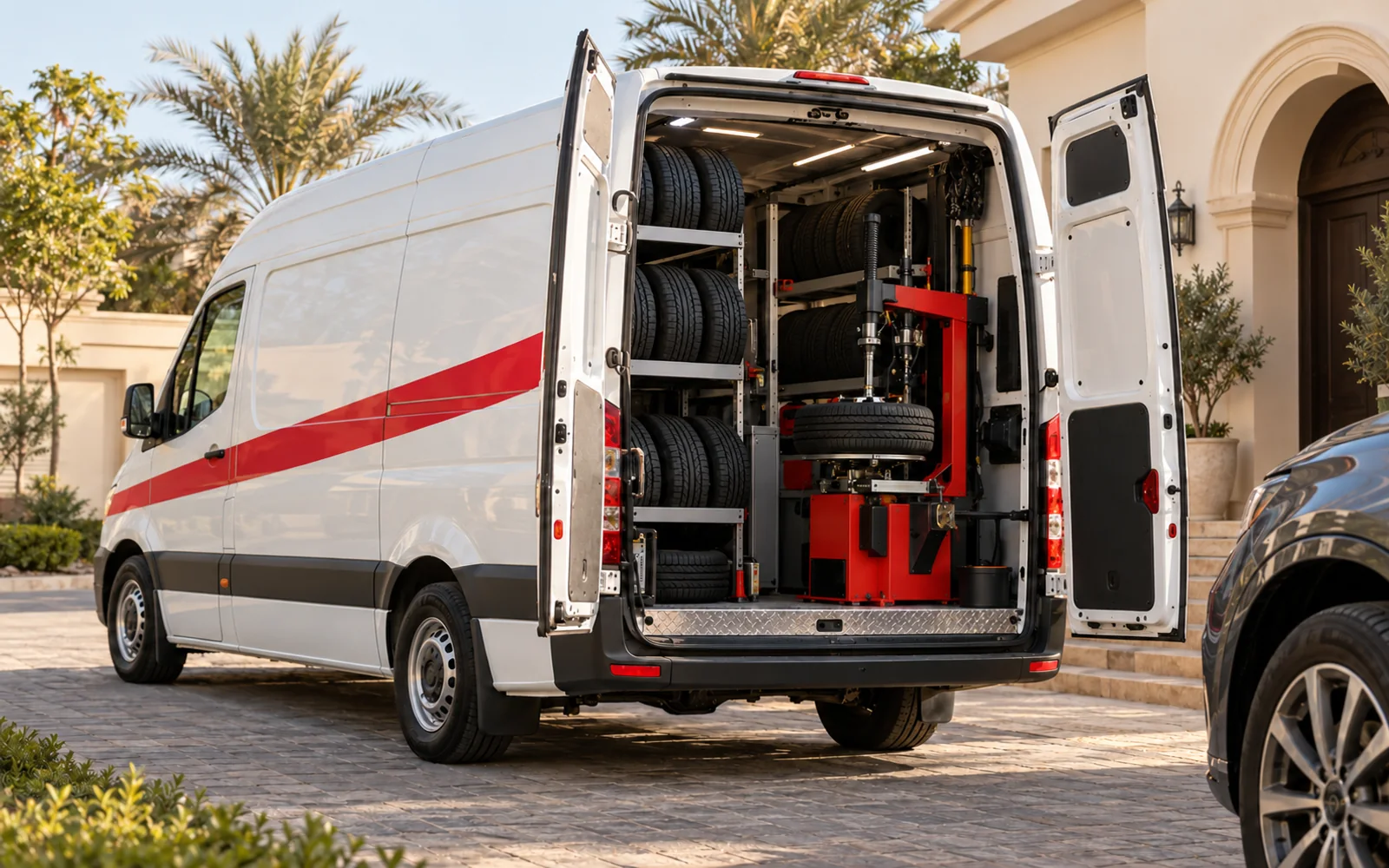






Tyre rotation with 800 UAE Tyres costs from AED 100 and means moving each wheel to a different position on the car, following the pattern for your drivetrain, so all four tyres wear evenly. We do it at your home or office in about 30–45 minutes, measure tread on every tyre first, and rebalance any wheel that needs it. Done every 8,000–10,000 km, it typically adds several thousand kilometres to a set.
What's included
- Tread depth measurement at three points across each tyre before rotation
- Rotation in the correct pattern for FWD, RWD, AWD or 4x4
- Directional and staggered fitments handled correctly
- Balance check, with rebalancing of any wheel that needs it
- Pressures reset for the new front and rear positions
- TPMS relearn where the car tracks sensor positions
Signs you need it
- It has been 8,000–10,000 km since the tyres were fitted or last rotated
- The front tyres have noticeably less tread than the rears, or vice versa
- You are about to fit two new tyres and want to plan positions
- Your car is AWD and the maker recommends equal tread on all four
- You are having the wheels balanced or the car serviced anyway
How the job runs
- Book and share the car. Tell us the car model and approximate mileage since the tyres were fitted or last rotated. That tells us the pattern and whether the timing is right.
- Measure first. Each tyre's tread is measured on the inner, centre and outer ribs. Uneven readings across one tyre point to an alignment or pressure problem, which we note for you.
- Rotate and balance. Wheels are moved in the right pattern, checked on the balancer if needed, and refitted with the nuts torqued to specification.
- Set pressures and record. Pressures are set for each axle, the TPMS is relearned if required, and you receive the tread readings on WhatsApp so the next rotation can be compared.
Why tyre rotation makes a set last longer
Tyre rotation works because the front and rear tyres wear at different rates. On a front-wheel-drive car such as a Corolla, Sunny, Elantra or Civic, the front tyres steer, brake and drive, and commonly wear 1.5 to 2 times faster than the rears.
Without rotation, the fronts reach 1.6 mm while the rears still have 4–5 mm, and you end up buying tyres in pairs at different times. With regular rotation, all four wear down together, so you get the full life from every tyre and replace them as a matched set.
There is a safety side too. A set worn evenly behaves predictably in an emergency stop, whereas a car with fresh fronts and worn rears is more prone to oversteer in a sudden swerve.
Rotation patterns by drivetrain
The rotation pattern depends on which wheels drive the car and on the type of tyre. Using the wrong pattern, or rotating directional tyres side to side, can make a tyre run backwards and reduce wet grip.
Cars with a different tyre size front and rear, common on BMW, Mercedes-AMG, Porsche and Tesla Performance models, cannot rotate between axles at all. On those, only side-to-side swaps on the same axle are possible, and only with non-directional tyres.
- Front-wheel drive: fronts go straight back, rears cross to the opposite front
- Rear-wheel drive and 4x4: rears go straight forward, fronts cross to the opposite rear
- All-wheel drive: X-pattern, every wheel crosses diagonally
- Directional tyres: front-to-back on the same side only
- Staggered sizes: side to side on the same axle, non-directional tyres only
- Five-tyre rotation on 4x4s with a matching full-size spare
How often to rotate tyres in the UAE
Rotate every 8,000–10,000 km, which for many UAE drivers works out at every six to nine months, or at every second oil change. If you drive long highway commutes such as Sharjah to Dubai Investments Park or Abu Dhabi to Dubai, that can be every four to five months.
Rotation also gives a regular chance to catch problems early. Tread readings taken at each rotation show whether one tyre is wearing on its inner edge, which suggests alignment, or in the centre, which suggests overinflation, before the damage is expensive.
When rotation will not help
Rotation evens out normal wear but does not fix the cause of abnormal wear. If a tyre is worn heavily on one edge, moving it to another corner spreads the problem rather than solving it. The car needs an alignment first, which we can book at a partner workshop.
Rotation also stops making sense when the tread difference between tyres is already large, roughly more than 3 mm, or when the oldest tyres are close to five years. In those cases, new tyres on the axle that needs them, with the better pair moved to the rear, is usually the right answer.
Pricing
Tyre rotation starts at AED 100 at your location, including tread measurement, rotation, balance check and pressure setting. Rebalancing wheels during the same visit is included where only minor weight is needed; a full four-wheel rebalance is quoted with the booking. Five-tyre rotation on 4x4s may cost slightly more.