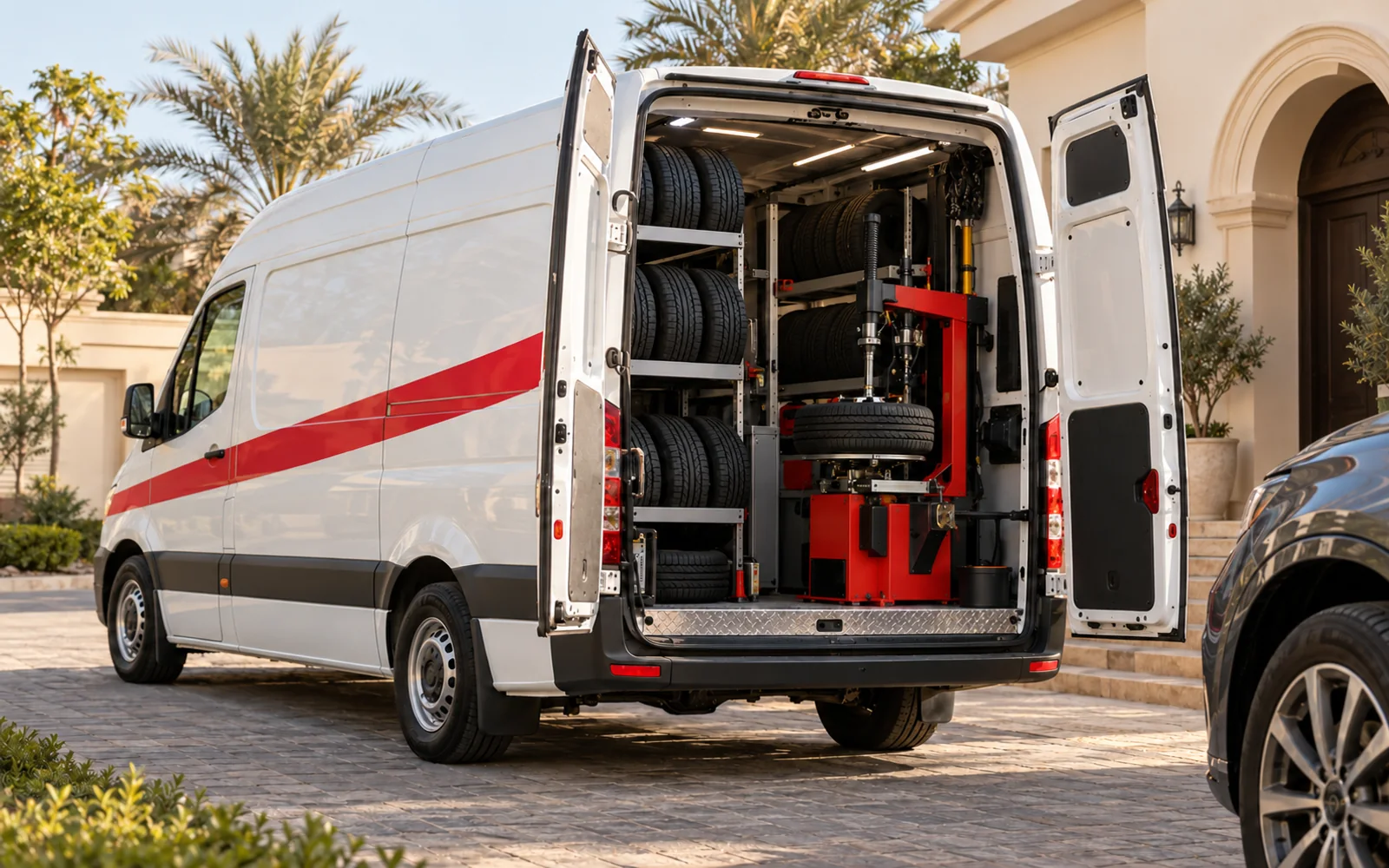






A mobile tyre pressure check from 800 UAE Tyres costs from AED 100 and covers all four tyres plus the spare, set to your car's specification with nitrogen, followed by a TPMS reset. A technician comes to your home or office, also checks each tyre for nails, cracks and slow leaks, and finishes in about 15–30 minutes. It is the simplest way to deal with a warning light that will not go off.
What's included
- Cold pressure reading on all four tyres and the spare with a calibrated gauge
- Setting pressures to the door-placard figure for your load
- Nitrogen top-up, or a full purge and fill on request
- TPMS reset or sensor relearn so the warning light clears
- Visual check for nails, cuts, bulges and sidewall cracking
- Tread depth reading on each tyre and DOT date check
- New valve caps where missing
Signs you need it
- Your TPMS warning light is on or flashing
- The car feels heavy to steer or rolls less freely
- Fuel consumption has crept up without any other reason
- You are about to drive a long distance, such as Dubai to Abu Dhabi or Oman
- You have just returned from the desert and the tyres were aired down
- You have not checked tyre pressure in more than a month
How the job runs
- Book a visit. Message us with your location and car. Early morning or evening slots give the most accurate cold readings in summer, because tyres heat up quickly in the sun.
- Read and inspect. The technician reads each tyre's pressure before adding anything, so you can see which one is losing air, and inspects the tread and sidewalls.
- Set to specification. Pressures are set to the placard figure, front and rear separately, with nitrogen. The spare is set to its own figure, often 60 psi for a space-saver.
- Reset and report. The TPMS is reset or relearned, and you get a WhatsApp summary of pressures, tread depths, tyre ages and anything that needs attention.
The right tyre pressure for your car
The correct tyre pressure for your car is printed on the placard inside the driver's door jamb, sometimes inside the fuel flap or glovebox. It is not the number moulded on the tyre sidewall, which is the maximum the tyre can hold.
Typical figures are 30–35 psi for small cars and sedans, 32–38 psi for SUVs, and 35–42 psi for heavy EVs and pickups when loaded. Many placards give a higher figure for a fully loaded car or sustained high speed, which is worth using for a family trip to Al Ain or Fujairah.
Pressure must be read cold, meaning before driving or after the car has stood in the shade for at least three hours. A tyre that has just done 20 minutes on the highway can read 3–5 psi higher than its cold figure, and letting air out at that point leaves it underinflated.
How UAE heat affects tyre pressure
Tyre pressure rises by roughly 1 psi for every 5–6°C increase in tyre temperature. Between a cool January morning and a car parked in the sun in August, that can mean a swing of 6–8 psi on the same tyre without any air being added or lost.
That swing is why pressure that seemed right in winter can be too high in summer, and why tyres set on a hot afternoon end up underinflated on a cooler night. Underinflation is the more dangerous of the two: it flexes the sidewall, builds heat, and is a leading cause of the tyre failures seen on UAE highways in summer.
- Check pressures at least once a month and before every long trip
- Always check cold, early morning if possible
- Never let air out of a hot tyre to bring it down to the placard figure
- Re-inflate after desert driving before returning to the highway
- Include the spare, which loses 1–2 psi a month on its own
Nitrogen inflation: what it does and does not do
Nitrogen is widely used at UAE tyre shops, and it has a modest real benefit: being dry and made of larger molecules, it seeps through the tyre more slowly than compressed air and its pressure varies a little less with temperature. Tyres filled with nitrogen tend to stay closer to the right pressure between checks.
It is not a substitute for checking. A nitrogen-filled tyre with a nail in it loses pressure just as quickly as one filled with air. Mixing nitrogen and air is harmless; topping up with air at a petrol station simply dilutes the benefit.
TPMS warnings and sensor resets
A TPMS warning means at least one tyre is about 20–25% below its target, or the system has a fault. A steady light usually means low pressure; a light that flashes for a minute and then stays on usually means a sensor fault or a sensor battery that has died.
Many Japanese and Korean cars need a reset button pressed after inflation, while most European cars and many newer Toyota, Nissan and Hyundai models relearn automatically after a short drive or need a scan tool. We carry a TPMS tool that reads each sensor, so if one is dead we can tell you which and quote a replacement rather than guess.
Pricing
A mobile tyre pressure check costs from AED 100 per car and includes all four tyres and the spare, nitrogen top-up, TPMS reset and a written summary. If we find a puncture, the repair is quoted on the spot and can be done on the same visit. Replacement TPMS sensors are quoted per car model.