





The short answer
- Typical sedan pressure
- 32–36 psi cold (Corolla, Camry, Sunny, Altima)
- Typical large SUV pressure
- 30–35 psi cold (Land Cruiser, Patrol, Prado)
- Where the correct figure is
- Sticker on the driver's door pillar, sometimes inside the fuel flap or glovebox
- Heat effect in summer
- Readings rise about 2–4 psi after driving or sun; check cold
- Desert air-down
- About 15–18 psi for dunes, re-inflate before the highway
- How often to check
- Every two weeks and before any long drive or desert trip
Where to find your correct tyre pressure
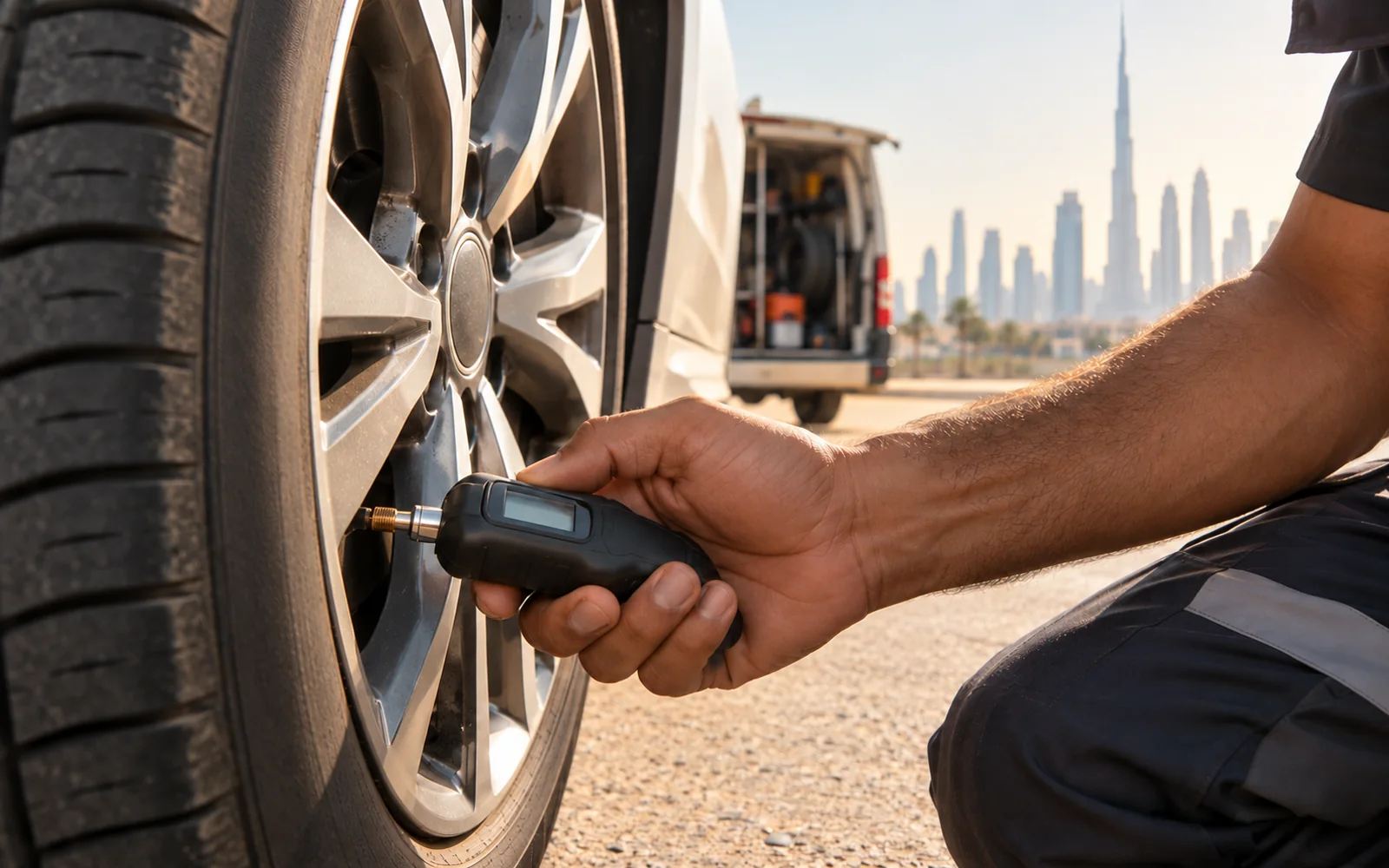
Your correct pressure is on the tyre placard, a sticker on the driver's door pillar that you see when the door is open. On some cars it sits inside the fuel flap, on the edge of the door itself or in the glovebox, and the owner's manual repeats it. The placard lists the original tyre size and a cold pressure for the front and rear axle, often with a second set of figures for a full load, in psi, bar and kPa.
The number moulded on the tyre sidewall is not the pressure to run. It reads something like "MAX PRESS 51 PSI" or "350 kPa" and is the highest pressure the tyre structure can safely hold when carrying its maximum load. Filling a Corolla to 51 psi because the sidewall says so gives a hard, bouncy ride, a smaller contact patch and longer braking distances. The car maker chose the placard figure for that specific weight, suspension and tyre size, so the placard wins.
If you have changed tyre size, for example from 16-inch to 18-inch wheels, or fitted XL (extra load) tyres, the placard figure may need a small adjustment of 2–3 psi to carry the same load. A tyre shop can work this out from load tables; when in doubt, keep the placard number as the minimum.
Cold vs hot readings in UAE heat
Placard pressures are cold pressures, meaning the tyre is at roughly air temperature and has not been driven more than a couple of kilometres. Air in a tyre gains about 1 psi for every 5–6°C rise, so after 20 minutes on Sheikh Zayed Road or an afternoon parked in direct sun a tyre set at 33 psi can easily read 35–37 psi. That rise is normal and already allowed for in the tyre design.
Check pressure first thing in the morning before driving, or after the car has been parked for at least three hours in shade or a basement car park. Petrol station checks after a long drive will always read high. Never let air out of hot tyres to bring them down to the placard number; once they cool, they will be several psi under-inflated, which is the condition that leads to overheating and failure.
Seasonal swings matter too. A tyre set to 34 psi on a 38°C August night can read 30–31 psi on a 16°C January morning in Al Ain or Hatta, so recheck when the weather turns. Tyres also lose roughly 1–2 psi a month through natural permeation, more if a valve core or rim seal is ageing.
Front, rear and fully loaded pressures
Front and rear pressures are often different, and the placard shows both. Front-heavy sedans and SUVs may call for the same figure all round, while many European cars list 2–4 psi more at the rear, and pickups and vans list much higher rear figures when loaded. Setting all four tyres to one number from memory is a common mistake.
When the car is full, raise pressures to the loaded figure on the placard. A family of seven in a Patrol with luggage for an Oman trip, a Hilux with a tonne of tiles in the bed, or a Hiace carrying 14 passengers all need the higher numbers. Running a heavily loaded vehicle at the light-load pressure lets the sidewalls flex more, builds heat and shortens tyre life.
- Light load: driver plus one passenger and little luggage, use the standard placard figure.
- Full load: all seats taken or heavy cargo, use the loaded figure, typically 3–6 psi higher at the rear on cars and SUVs.
- Towing a boat, caravan or jet-ski trailer: add the loaded rear figure and check the trailer tyres separately.
Under-inflation and over-inflation risks in summer
Under-inflation is the main cause of summer blowouts in the UAE. A tyre 6–8 psi low flexes much more at the sidewall with every rotation, and on a road surface at 60–70°C that flexing heats the rubber and cords from the inside. At sustained 120–140 km/h on the E11 or E311 the internal heat can separate the tread from the casing, which is why the debris on the hard shoulder in July and August is mostly tread strips.
Low pressure also wears the outer shoulders of the tread, raises fuel consumption by a few percent and makes the steering slow and vague. Over-inflation is less dangerous but still costly: the centre of the tread wears faster, the tyre grips less in an emergency stop, ride comfort drops, and the tyre is more likely to suffer impact damage on potholes, kerbs and the steep speed bumps common in residential communities.
- Signs of low pressure: heavier steering, the car pulling to one side, worn outer edges, a TPMS warning.
- Signs of high pressure: harsh ride over expansion joints, worn centre strip, the car feeling skittish on grooved concrete.
- A gauge costs AED 20–60 and is more reliable than many petrol station gauges, which are often knocked out of calibration.
Nitrogen inflation: what it does and does not do
Nitrogen keeps pressure slightly more stable over weeks, but it does not stop pressure rising in the heat and it is not required. Normal air is already about 78 percent nitrogen. Filling with near-pure nitrogen removes most of the oxygen and moisture, so the tyre loses pressure a little more slowly and the inside of the wheel stays drier. The rise of 2–4 psi on a hot afternoon still happens because every gas expands when heated.
UAE tyre shops usually charge around AED 5–10 per tyre for nitrogen, and many include it free when you buy new tyres. It is fine to pay for it, but it is not a safety upgrade, and it does not replace regular checks. If a nitrogen-filled tyre is low and only an air line is available, top up with air. Mixing the two causes no harm; you simply lose part of the small benefit.
Airing down for sand and dune driving
For dune driving in places like Al Faya, Big Red or Liwa, most 4x4 drivers drop to about 15–18 psi. Lower pressure lengthens the tyre footprint so it floats on soft sand instead of digging in. Experienced drivers sometimes go to 12–14 psi in very soft sand, but below about 15 psi the tyre can roll off the rim bead in a sharp turn on a slope unless you run beadlock wheels, so build up to it with a convoy and a recovery kit.
While aired down, keep speed low, roughly under 40–50 km/h, and avoid hard turns on firm surfaces, because the soft sidewalls overheat and deform quickly. Re-inflate to the placard pressure before you rejoin tarmac. A 12V portable compressor that connects to the battery fills four SUV tyres from 16 to 33 psi in roughly 10–20 minutes; cheap cigarette-socket pumps can take an hour and overheat. Many dune entry points have air stations, but queues on Friday afternoons are long, so carry your own.
TPMS: how tyre pressure monitoring works
A TPMS warning light, the yellow horseshoe symbol with an exclamation mark inside, means at least one tyre is roughly 20–25 percent below its set pressure or the system has a fault. Direct TPMS uses a battery-powered sensor inside each wheel, usually built into the valve, and most modern Toyota, Nissan, Lexus, Hyundai, Kia and Tesla models show the actual psi of each tyre on the dashboard. Indirect TPMS, used on many Volkswagen, Audi and some Honda and Mazda models, has no sensors in the wheels and instead watches the ABS wheel-speed signals for a tyre that spins faster because it has shrunk.
A steady light means low pressure: check all four with a gauge and inflate to the placard. A light that flashes for about a minute and then stays on points to a sensor or system fault. After adjusting pressures, indirect systems need a reset through the infotainment menu or a button, and some direct systems need a short drive above 25 km/h to relearn. Sensor batteries last roughly 5–10 years and are sealed, so the whole sensor is replaced. When you change tyres, ask for a new valve seal kit, and if the sensors are near the end of their life it is cheaper to replace them while the tyre is already off the rim.
| Vehicle type | Example UAE models | Front psi | Rear psi | Notes |
|---|---|---|---|---|
| City car | Nissan Sunny, Toyota Yaris, Mitsubishi Attrage | 32–35 | 32–35 | Small 14–15 inch tyres lose a bigger share of pressure per psi leak |
| Compact sedan | Toyota Corolla, Hyundai Elantra, Honda Civic | 32–36 | 32–35 | Add 2–3 psi at the rear with five adults |
| Mid-size sedan | Toyota Camry, Nissan Altima, Lexus ES | 33–36 | 33–36 | Often one figure all round |
| Sports or performance car on low-profile tyres | BMW 3 Series, Mercedes C-Class, Ford Mustang | 33–38 | 35–42 | Staggered sizes and run-flats; higher figures for high-speed use |
| Compact SUV or crossover | Toyota RAV4, Nissan X-Trail, Hyundai Tucson, MG ZS | 33–36 | 33–36 | Check loaded figure for family trips |
| Large SUV | Toyota Land Cruiser, Nissan Patrol, Lexus LX, Toyota Prado | 30–35 | 30–35 | Air down to 15–18 psi for dunes only |
| Pickup, unladen | Toyota Hilux, Nissan Navara, Mitsubishi L200 | 29–33 | 29–35 | Empty bed: lower rear keeps grip and comfort |
| Pickup, laden | Toyota Hilux, Nissan Navara, Mitsubishi L200 | 30–35 | 38–50 | Commercial LT tyres may list higher rear figures |
| Van or minibus | Toyota Hiace, Nissan Urvan | 44–50 | 50–65 | C-rated van tyres; never run them at car pressures |
| Electric car | Tesla Model 3, Tesla Model Y, BYD Atto 3 | 36–42 | 36–42 | Heavier batteries need higher pressure; Tesla lists 42 psi on many trims |