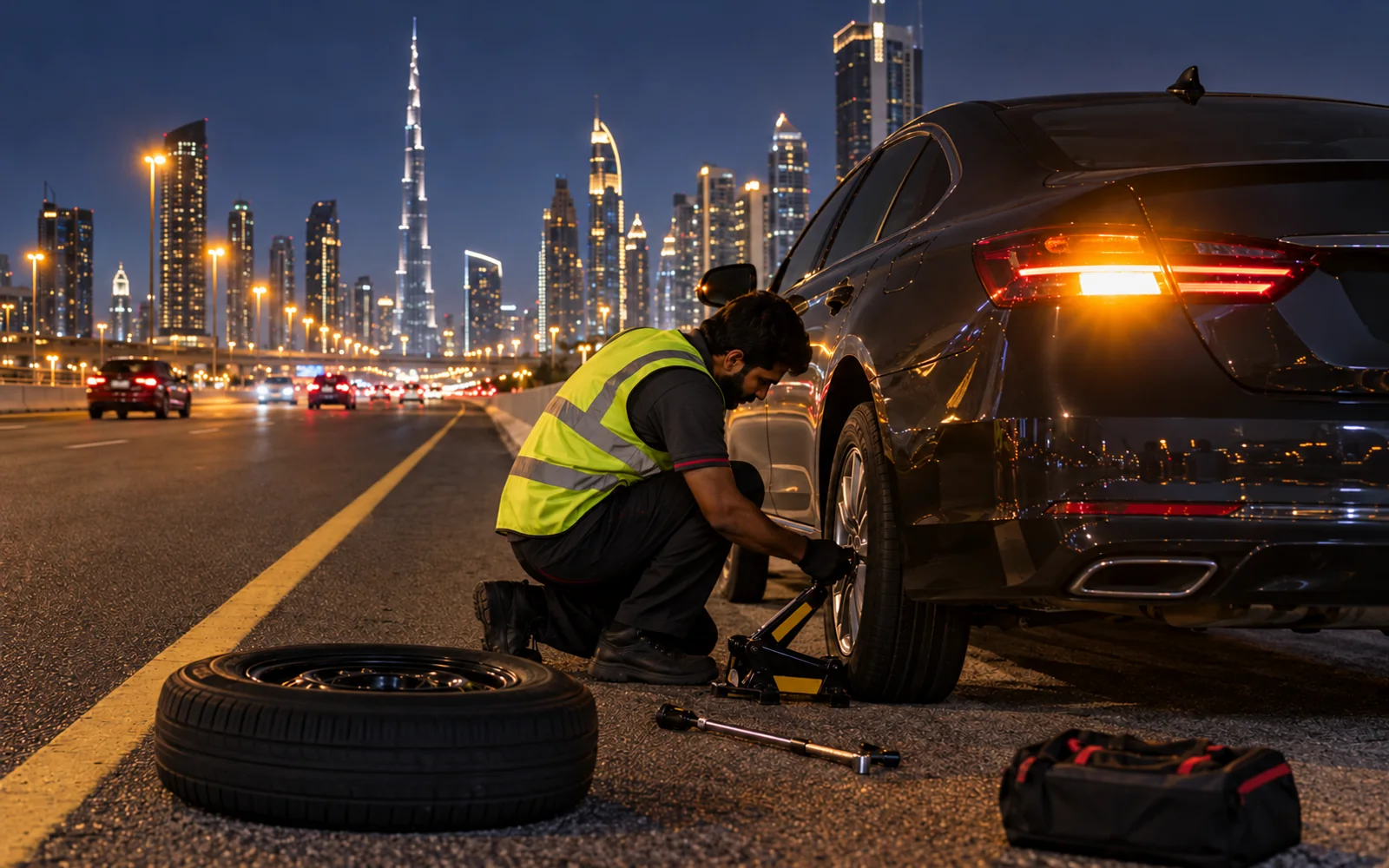






In an emergency tyre replacement, the first job is yours: hold the steering straight, ease off the accelerator without braking hard, switch on hazard lights and get the car onto the hard shoulder or the next exit. Once everyone is out of the car and behind the barrier, 800 UAE Tyres sends a technician 24 hours a day to the E11, E311, E611, E10, E12 and every road in between across Dubai, Abu Dhabi, Sharjah and Ajman. The van carries new tyres in common sizes, so the roadside tyre change is a full replacement rather than a temporary patch, or we fit your own spare if you prefer. Fitting starts from AED 100, with the tyre price confirmed on WhatsApp before dispatch.
The first 5 minutes after a blowout or flat on the highway
The safest reaction to a blowout is the opposite of instinct: keep the wheel straight and let the car slow down on its own instead of stamping on the brake. A sudden loss of pressure pulls the car toward the failed side, and hard braking or a sharp steering correction at speed is what turns a blowout into a crash.
Once the car is under control and below about 60 km/h, signal and move right. If a proper hard shoulder is close, stop there as far from the lane as possible. If you are on a bridge, a curve or a stretch with no shoulder and the next exit is near, roll slowly to it.
Then get people out of harm's way before you think about the tyre. Most serious injuries on UAE highway shoulders happen to people standing next to a stopped car, not to people inside a moving one.
- Hold the steering straight and lift off the accelerator gently
- Avoid hard braking until the car is stable and slowing
- Hazard lights on, then move to the hard shoulder or next exit
- Place the warning triangle well behind the car only if you can do it safely
- Everyone out on the passenger side and behind the barrier
- Call 999 if you are stopped somewhere dangerous, such as a live lane or a blind curve
Why summer blowouts happen on UAE roads
Most summer blowouts we attend come from the same three causes working together: low pressure, heat and age. A tyre running 6 to 8 psi below the door-placard figure flexes more with every rotation, and on an asphalt surface at 60 to 70°C that extra flexing builds heat inside the casing until the structure separates.
Age makes it worse. Rubber hardens and cracks faster in UAE heat, which is why a tyre with a DOT code of five years or more should be replaced even if the tread still looks deep. We regularly see blowouts on cars where three tyres are fairly new and one old tyre, often the spare moved onto the car last year, has failed.
Load is the third factor. A family SUV packed for a long drive to Hatta or Oman, running highway speeds for two hours in August, puts its tyres under the hardest test of the year. Check pressures cold in the morning before a trip like that, not at a petrol station after an hour on the road.
What happens on an emergency tyre replacement call
The technician arrives with a new tyre in your size already on the van, chosen from the sidewall photo and quote you approved on WhatsApp. The van carries a tyre changer, a wheel balancer, a trolley jack, impact tools and a compressor, so the new tyre is mounted on your rim, balanced and fitted at the roadside, typically in 20 to 30 minutes once work starts.
If you would rather keep the cost down tonight, we can fit your full-size spare instead and arrange the new tyre later. Either way, we inspect the other three tyres and the spare for cuts, bulges, low pressure and DOT age, because a blowout often signals that the rest of the set is close behind.
Before we leave, every wheel nut is torqued to spec and all pressures are set cold to the placard figure. We also ask you to have the nuts re-checked after roughly 50 to 100 km, as alloy rims can settle slightly once they heat up.
Roadside tyre change coverage on UAE highways
We cover the main highways linking Dubai, Abu Dhabi, Sharjah and Ajman, as well as city roads in all four. That includes the E11 from Ajman through Sharjah and Dubai down to Abu Dhabi, the E311 and E611 that carry most of the commuter and truck traffic inland, and the E10 and E12 around Abu Dhabi island, Yas and Saadiyat.
Arrival is typically 30 to 45 minutes in Dubai city areas and usually within about an hour on outer stretches, such as the E11 near Ghantoot or the E611 beyond Al Maktoum Airport. Send the pin, the direction you were travelling and the last exit or landmark, because on a dual carriageway the van needs to arrive on your side of the central barrier.
If the police or a recovery truck reach you first and move the car to a safer spot, just send us the new pin and we will meet you there.
What not to do after a flat on a UAE highway
The most expensive mistake is driving several kilometres on a flat to reach a familiar exit or petrol station. Within a few hundred metres the sidewall is crushed between rim and road, a repairable puncture becomes a scrap tyre, and the rim itself can be bent or cracked.
Temporary spares cause the second set of problems. A space-saver is typically limited to 80 km/h and short distances, so using one to finish a 130 km run from Dubai to Abu Dhabi at highway speed is asking for a second failure. Run-flat tyres on BMW, Mini and Mercedes typically allow about 80 km at up to 80 km/h after pressure loss, so check the car manual and book the replacement the same day.
- Do not drive kilometres on a flat to reach a familiar exit
- Do not exceed 80 km/h on a space-saver spare
- Do not stand between the car and moving traffic
- Do not jack the car on soft sand at the edge of the shoulder
- Do not rely on aerosol sealant for a cut in the sidewall