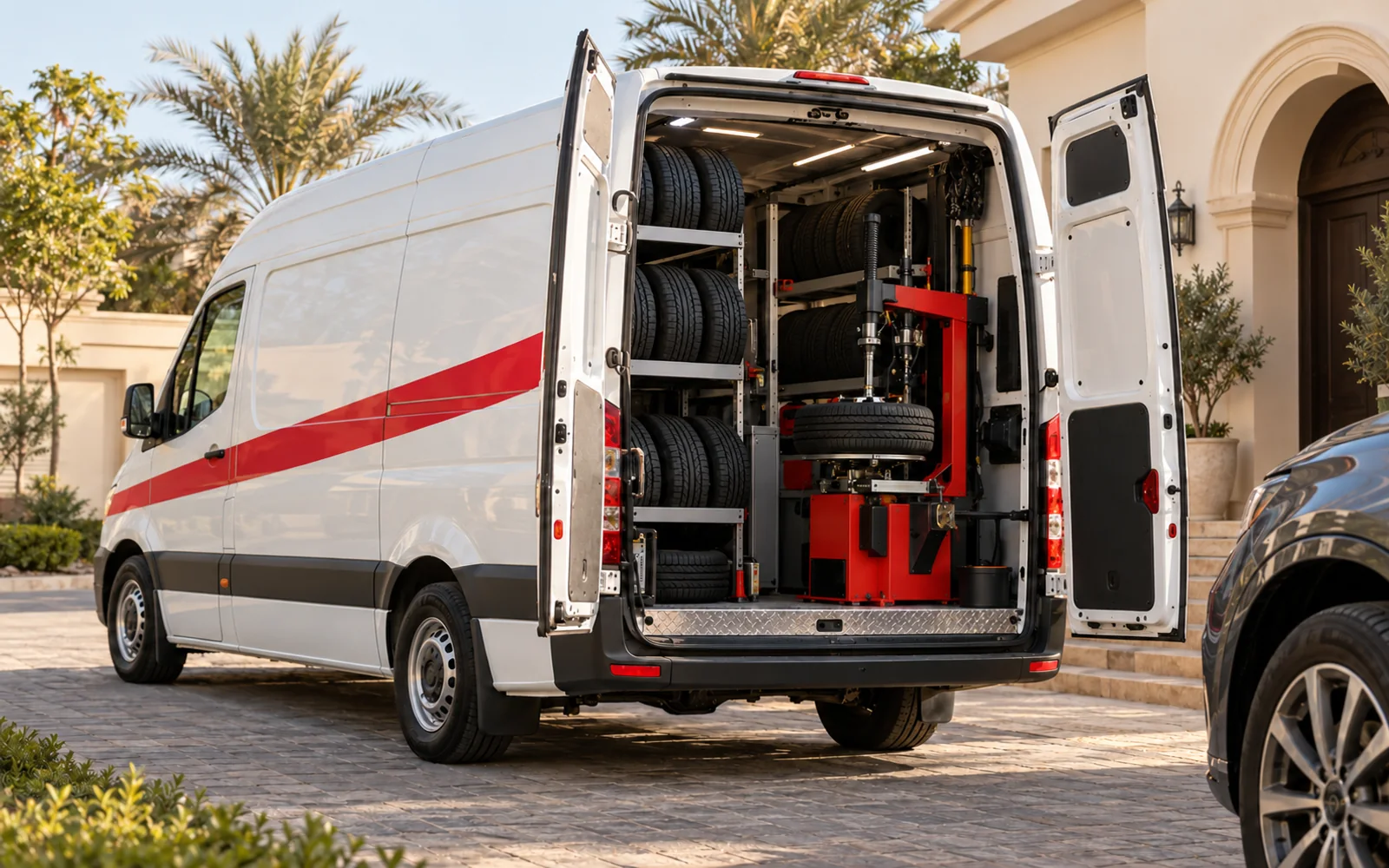






Flat tyre repair in Dubai, Abu Dhabi and Sharjah costs from AED 100 with 800 UAE Tyres, and a mobile technician typically reaches Dubai city areas in 30–45 minutes, 24 hours a day. We repair the tyre on the spot when the damage is in the tread and safe to fix, or fit a new tyre or your spare when it is not. You stay with the car; the van brings the tools.
What's included
- Call-out to your home, office, basement car park, mall parking or roadside location
- Full inspection of the tyre inside and out, including sidewall and bead
- Plug or plug-patch repair for tread punctures up to about 6 mm
- Re-inflation to the pressure on your door-jamb placard, with nitrogen on request
- Leak test with soapy water around the repair, valve and bead
- Wheel nuts torqued to the manufacturer figure with a calibrated wrench
- Honest advice and a WhatsApp quote if the tyre cannot be repaired
Signs you need it
- The tyre is visibly low or sitting on the rim
- Your TPMS warning light is on and one tyre reads 5 psi or more below the others
- The car pulls to one side or the steering feels heavy
- You hear a flapping or rumbling noise that gets faster with speed
- You find a nail, screw or bolt head in the tread
- A tyre keeps losing pressure every few days
How the job runs
- Send your location. Call or WhatsApp us with a live location pin, your car model and a photo of the tyre if you can. A photo of the sidewall size, such as 225/65 R17, lets us load the right tyre in case a repair is not possible.
- Technician arrives. A van with a jack, compressor, repair kit and torque wrench is dispatched. In Dubai city areas it usually arrives in 30–45 minutes; outer areas and late-night calls on the E311 or E611 can take a little longer.
- Inspect and decide. The wheel comes off and the tyre is checked for the puncture position, sidewall cuts and internal damage from being driven flat. You get a straight answer: repair, fit your spare, or replace.
- Repair, refit and test. We repair the tyre, inflate it, leak-test it, refit the wheel and torque the nuts. Pay by card, cash, Tabby or Tamara, and drive off.
What a flat tyre repair at your location involves
A flat tyre repair means sealing a puncture so the tyre holds air safely for the rest of its life, not just until the next petrol station. Our technicians remove the wheel, find the object, and decide whether the tyre can be repaired before any plug goes in. That decision matters more than the repair itself.
For a simple nail or screw in the tread, the repair takes 20–40 minutes from arrival. We use a plug for clean small holes and a combination plug-patch, fitted from inside the tyre, where the angle of the hole or the tyre type calls for it. The tyre is then inflated to the figure on your door-jamb placard, usually 32–36 psi for a sedan and 33–38 psi for an SUV, and leak-tested.
If you are on the hard shoulder of Sheikh Zayed Road or Mohammed bin Zayed Road, the technician parks behind you with hazard lights and cones, and the work is done from the verge side wherever possible. Stay behind the barrier while we work.
When a puncture can be repaired and when it cannot
A puncture is repairable when it sits in the central tread area, the hole is no larger than about 6 mm, and the tyre has not been driven on while flat. Anything outside those limits is a replacement, and we will tell you so even when a plug would hold air for a while.
Driving even 1–2 km on a flat tyre at UAE road temperatures can crush the inner sidewall, leaving a ring of grey rubber dust inside the tyre. That damage is invisible from outside and makes the tyre unsafe at highway speed. We check for it on every job.
- Repairable: nail or screw in the tread, hole under 6 mm, tyre not driven flat
- Not repairable: any cut or bulge on the sidewall or shoulder
- Not repairable: punctures closer than about 40 cm to an existing repair
- Not repairable: tread below 1.6 mm, the UAE legal minimum
- Usually not repairable: run-flat tyres driven beyond the maker's zero-pressure limit
Why tyres go flat so often in the UAE
Most flats we attend are caused by screws and nails picked up near construction sites, villa renovations and industrial areas such as Al Quoz, Mussafah and Sharjah Industrial Area. The next most common cause is slow leaks around the bead or valve, which get worse in summer when the air inside a hot tyre expands and contracts every day.
Kerb strikes in tight residential parking and fast hits on speed bumps also pinch tyres against the rim, especially low-profile tyres on 19–21 inch wheels. A pinched sidewall often looks fine at first and then loses air over a few days.
Tyre age plays a part too. Rubber hardens faster when road surfaces reach 60–70°C, so a five-year-old tyre with plenty of tread is more likely to crack around the bead and leak. Check the DOT code on the sidewall: 2321 means week 23 of 2021, which would be due for replacement in this climate.
What to do while you wait for us
Stop driving as soon as you notice the flat and pull over where it is safe. Every extra kilometre on a deflated tyre reduces the chance that it can be repaired. On a highway, take the next exit if the car is still controllable at low speed; otherwise use the hard shoulder, switch on hazards and wait behind the barrier.
Do not use aerosol tyre sealant if you want the tyre repaired properly. The sealant coats the inside of the tyre and the TPMS sensor, and many shops will then refuse a plug-patch repair. If the nail is still in the tread, leave it there; it is partly sealing the hole.
Pricing
Flat tyre repair starts at AED 100 including call-out, repair and re-inflation for one tyre. Additional punctures on the same visit are quoted on site, usually AED 40–60 each. If the tyre cannot be repaired, the replacement tyre is quoted on WhatsApp by brand and size before we fit it, and you pay only once you agree.