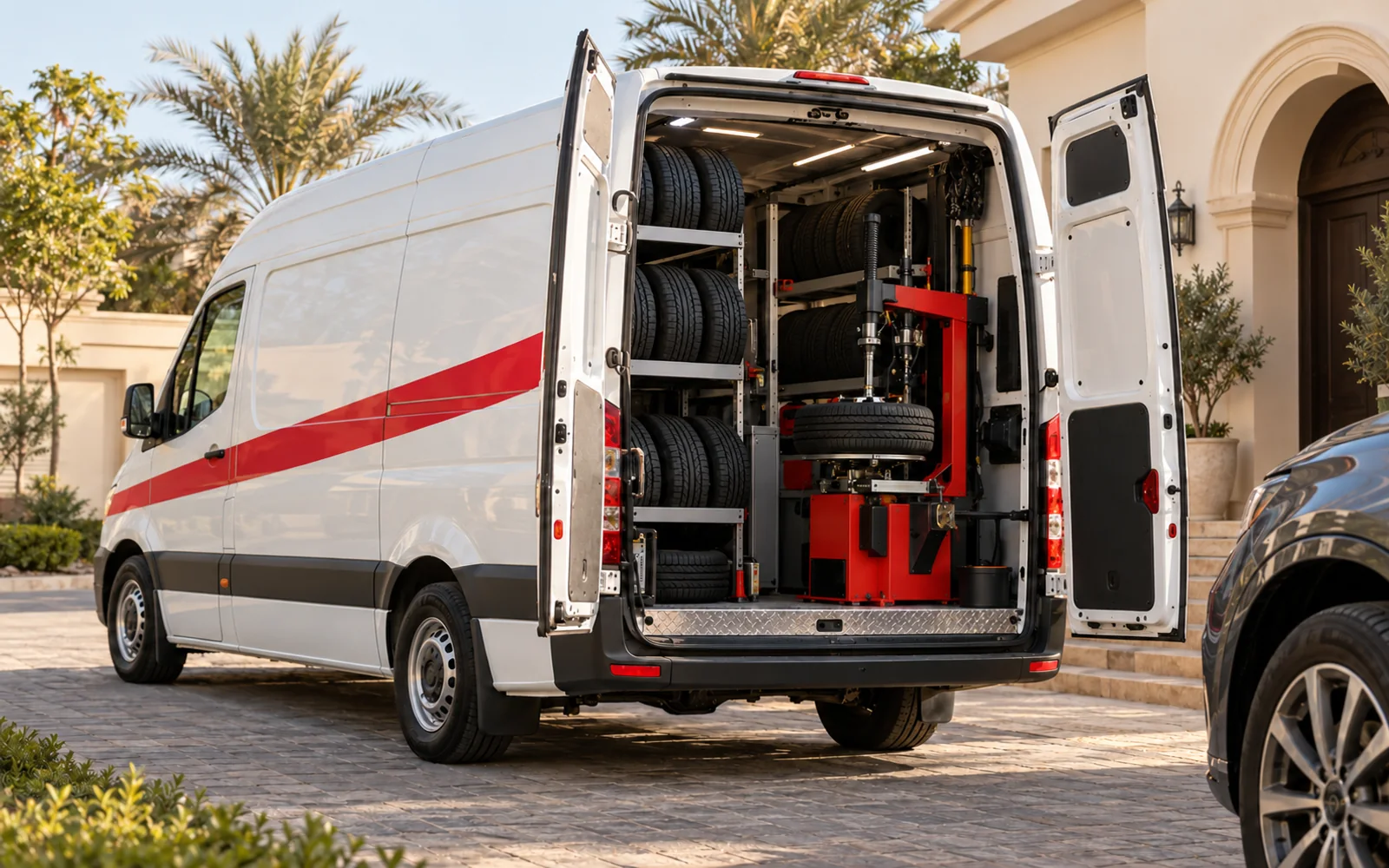






Tyre puncture repair near you costs from AED 100 with 800 UAE Tyres, done at your home, office or car park across Dubai, Abu Dhabi, Sharjah and Ajman. It is the service for a tyre that is still holding some air: a nail in the tread, a slow leak that needs topping up every few days, or a TPMS warning that keeps coming back. We find the leak, repair it properly, and test it before we leave.
What's included
- Leak search on the tread, valve, bead and rim with soapy water
- Removal of the nail, screw or debris
- Internal inspection with the tyre off the rim when needed
- Plug-patch (mushroom) repair from inside for the most durable result
- Valve core or valve replacement if the leak is there
- Bead seat cleaning and sealing for rim leaks on alloy wheels
- Rebalancing after an internal repair
Signs you need it
- One tyre needs air every few days while the others stay steady
- Your TPMS light comes on in the morning and goes off after driving
- You can see a nail or screw head in the tread but the tyre still holds air
- You hear a faint hiss near a wheel when the car is parked
- A tyre was previously plugged from outside and has started leaking again
How the job runs
- Tell us the symptoms. Let us know which tyre is losing air and how fast: overnight, every few days or only after a long drive. That tells the technician where to look first.
- Find the leak. The tyre is inflated to full pressure and sprayed with soapy water. Bubbles show the exact source, whether it is a screw in the tread, a valve, or air escaping between tyre and rim.
- Repair the right way. For tread punctures, the tyre comes off the rim, the hole is prepared and a plug-patch is fitted from inside. Valve and bead leaks are fixed at the source.
- Test and refit. The tyre is re-inflated, rebalanced if it came off the rim, leak-tested again and refitted with the nuts torqued to specification.
Plug, patch or plug-patch: which repair lasts
The longest-lasting tyre puncture repair is a combination plug-patch fitted from inside the tyre. The stem fills the hole through the tread so water and sand cannot reach the steel belts, and the patch seals the inner liner so air cannot escape.
A string plug pushed in from outside, the kind many roadside shops use, is quick and often holds for months. But it does not seal the inner liner, and the hole is never inspected from inside. In UAE heat, the rubber around an outside plug can loosen, and a slow leak returns.
We use outside plugs only as a temporary fix when time or location makes removing the tyre impractical, and we tell you when that is the case. For a permanent repair, the tyre comes off the rim.
Slow leaks that are not punctures
Many of the slow leaks we investigate are not punctures at all. The air is escaping through a worn valve, a loose valve core, or the bead where the tyre meets the rim.
Alloy rims corrode at the bead seat over time, especially on cars washed often or driven through flooded roads after winter rain. The corrosion leaves a rough surface that the tyre cannot seal against. Cleaning the bead seat back to bare metal and applying bead sealer usually fixes it.
Valves age too. Rubber snap-in valves crack after a few UAE summers, and TPMS valves have seals that harden. Replacing a valve or valve core is a small job that is often overlooked.
- Tread puncture: bubbles at one spot in the tread
- Valve leak: bubbles at the valve stem or around the cap
- Bead leak: a ring of bubbles where the tyre meets the rim
- Cracked rim: bubbles from the alloy itself, usually after a pothole or kerb hit
Puncture repair near you, without driving on a soft tyre
Driving to a tyre shop on a tyre that is 10–15 psi low builds heat in the sidewall, and on a 45°C afternoon that can turn a repairable puncture into a scrapped tyre. Having the repair done where the car is parked removes that risk.
If you need to move the car before we arrive, top it up at a petrol station to the placard pressure first and drive gently. Most ADNOC, ENOC and Emarat stations have air machines, and many offer nitrogen.
Repair limits we follow
We repair punctures in the central three-quarters of the tread width, up to about 6 mm across, in tyres with legal tread and no internal damage. Shoulder and sidewall damage, previous repairs too close to the new hole, and tyres that have been driven flat are not repaired.
Speed-rated tyres (V, W, Y) can be repaired under the same rules, but some tyre makers reduce the rating after a repair. If yours is one of them, we tell you. Run-flat tyres are repaired only when the maker allows it and the tyre has not been run at zero pressure.
Pricing
Tyre puncture repair starts at AED 100 for one tyre, including call-out, leak search, internal plug-patch repair, rebalancing and inflation. A second puncture on the same visit is usually AED 40–60. Valve replacement and bead sealing are quoted on site and are normally a small addition.